What I’ve Learned Designing CDP the Right Way
When teams implement Sitecore CDP, the focus usually goes to personalization use cases, dashboards, and decision models. But in real projects, I’ve seen something different. If your event model and identity strategy are weak, nothing else works properly. Personalization behaves inconsistently. Reports don’t add up. Profiles get duplicated. Consent becomes messy.
So in this post, I want to walk through what actually matters when designing Sitecore CDP — based on what I’ve seen in real implementations.
1. Event Taxonomy Design for Sitecore CDP
Your event taxonomy is your foundation.
If you don’t define it early and clearly, every team will send data differently — and you’ll spend months fixing it later.
Start With Business Intent, Not Pages
A common mistake is modeling events around pages:
- home_page_click
- product_page_click
- checkout_page_click
This ties your data to the UI.
Instead, model around user intent:
- product_viewed
- product_added_to_cart
- checkout_started
- checkout_completed
Now your model works across:
- Web
- Mobile apps
- Email journeys
- Future channels
That’s how you future-proof it.
Naming Conventions
Keep it simple and consistent.
I recommend:
lowercase + underscores + business action
Examples:
- product_viewed
- cart_updated
- form_submitted
- account_logged_in
Avoid:
- Environment prefixes (dev_, prod_)
- Version numbers in event names
- Brand-specific naming unless absolutely required
Let schema versioning handle evolution — not the event name.
Versioning Strategy
Events will evolve. That’s normal.
The mistake is changing them without a plan.
What works well:
- Add a
schema_versionfield inside the payload - Only add new optional fields
- Avoid deleting existing properties suddenly
If a field must be removed, deprecate it first.
Remember: decision models might still be using it.
Future-Proofing Your Event Model
Before finalizing your taxonomy, ask:
- Will this work across brands?
- Will this work in mobile apps?
- Will this work in offline or call center scenarios?
- Will this still make sense 3 years from now?
For example:
Instead of web_banner_clicked use promotion_clicked
Now it works everywhere.
That small decision saves major rework later.
2. Designing Identity Resolution in Complex Ecosystems
Identity is where most CDP projects struggle.
In reality, one user can have:
- Anonymous browser ID
- CRM ID
- Mobile app ID
- Loyalty ID
If you don’t define how these connect, you’ll end up with duplicate or broken profiles.
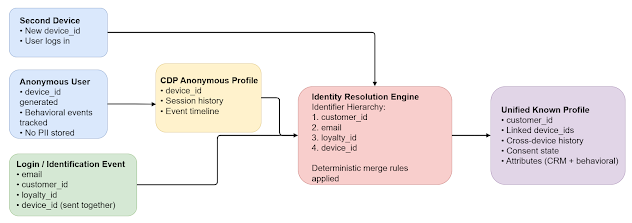
Anonymous → Known Transitions
This is a critical moment.
A user browses anonymously. Then they log in or submit their email.
What should happen?
You must:
- Link anonymous history to the known profile
- Merge safely
- Avoid losing past behavioral data
Best practice:
- Send both identifiers during the transition
- Merge using strong identifiers (email, customer ID)
- Never merge using weak signals like name only
If this is not designed carefully, you’ll see:
- Fragmented journeys
- Reset personalization
- Inconsistent reporting
Multi-Device and Multi-Brand Scenarios
In enterprise setups, things get more complex.
A customer might:
- Browse Brand A on desktop
- Use Brand B mobile app
- Purchase through call center
Now you must decide:
- Are profiles shared across brands?
- Is identity enterprise-wide or brand-level?
- What about regional data boundaries?
Define clearly:
Identity Scope
- Brand-level
- Region-level
- Enterprise-level
Identifier Priority
For example:
- Customer ID
- Loyalty ID
- Device ID
Document this. Socialize it. Govern it.
Identity chaos usually comes from unclear ownership — not technical limitations.
3. Data Modeling Mistakes I See Often
Over-Collection
Some teams send everything:
- Every click
- Every scroll
- Every hover
More data does not mean better personalization.
It usually means:
- Higher storage cost
- Slower processing
- Noisy segments
- Harder debugging
Before sending any event, ask:
Will this drive a business decision?
If not, don’t send it.
Poor Event Normalization
Across brands, I’ve seen this:
Brand A sends:
productId
Brand B sends:
product_id
Brand C sends:
sku (Stock Keeping Unit)
Now try building a unified segment.
Standardize:
- Attribute names
- Data types
- Value formats
Create a shared event contract and enforce it.
Identity Chaos
This is the hardest to fix later.
Symptoms:
- Duplicate profiles
- Conflicting attributes
- Random merges
- Personalization behaving unpredictably
Root cause:
No documented identity strategy.
Identity resolution is not just configuration.
It’s enterprise data architecture.
4. GDPR and Consent Architecture with CDP
Consent must be part of your data model from day one.
Not something added later.
What Data to Send
Send:
- Behavioral interaction data
- Pseudonymous identifiers
- Business events
- Consent status
Be cautious with:
- Sensitive personal data
- Financial information
- Health data
Minimize data collection wherever possible.
What Data to Suppress
Do not send:
- Events before required consent (based on region)
- Users who have opted out
- Internal test traffic
Consent logic should sit before data flows into CDP.
Modeling Consent Events
Treat consent as its own event.
For example:
consent_updated
- consent_type
- consent_status
- timestamp
- source
This gives you:
- Full audit history
- Clean compliance reporting
- Better suppression logic
- Dynamic personalization based on consent state
And most importantly — transparency.
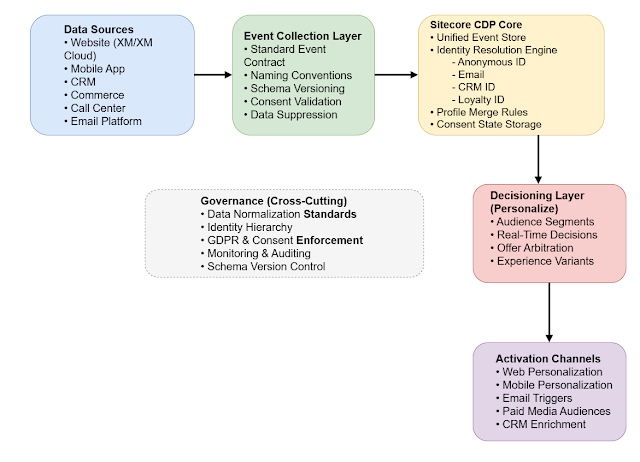
Practical Architecture Diagram Outline
Real Enterprise Case Study Example
Final Thoughts
Sitecore CDP is not just about connecting data sources. It’s about designing a clean, scalable event and identity foundation.
If you rush taxonomy and identity design, you’ll spend years fixing personalization issues.
If you invest time upfront, you unlock:
- Reliable personalization
- Accurate reporting
- Predictable decision models
- Cleaner compliance
In my experience, CDP success has very little to do with features — and everything to do with architecture discipline.
References